Subscribe to our show
Why Muscle Strength Is the Ultimate Predictor of Longevity
I’m showing you why one of the most important longevity markers may be something as simple as getting out of a chair without using your hands. I break down fascinating research connecting greater muscular strength with lower mortality risk and explain why cardio alone is not enough to protect your independence as you age. Then I give you a simple strategy for testing your strength, building muscle with resistance training, and supporting those results with protein and targeted supplements so you can stay strong, capable, and powerful for years to come.
What you’ll learn:
00:00 How a simple chair stand test can predict your overall longevity and functional independence better than cardio or body weight.
00:46 What true functional strength means for daily living and why visible muscle definition is not the main priority as you age.
02:25 Why focusing solely on cardio exercise can leave you weak, prone to injury, and struggling with balance.
03:18 Key findings from a major JAMA study showing that stronger women have a 30% to 33% lower risk of mortality.
06:17 How to assess your baseline functional strength using a hand grip dynamometer or a simple chair stand test.
07:00 How to structure a basic two-day full-body resistance training program using body weight, bands, or dumbbells.
07:46 Optimal daily protein targets and key targeted supplements to maximize muscle protein synthesis and recovery.
08:35 Why resistance training must be the core foundation of any fitness regimen for women over 40 before adding cardio or HIIT.
Resources Mentioned in this episode
Lindora Metabolic Health and Wellness Centers
Mitopure supports the cellular energy that allows your muscles to actually respond and adapt. Mitopure gummies make it simple. Visit https://timeline.com/jjvirgin for 20% off your order.
00:00
Speaker 1
How easily can you get out of a chair without using your hands? Because it turns out that simple movement might actually predict how long you live better than your weight, your body mass index, or how much cardio you’re doing. And most people completely overlook it. So in this video, I’m going to walk you through a simple test what the research shows about strength and longevity and what you should actually be doing instead. And stay with me until the end, because I’m going to share exactly how I structure this with the women I coach so you can start applying it right away. Hey, I’m JJ Virgin, PhD, dropout. Sorry, Mom. Turned four time New York Times best selling author.
00:46
Speaker 1
As a certified nutrition specialist, fitness hall of famer, and globally recognized leader in health, I’m driven to keep asking the tough questions and use my podcast to simplify the science of health into actionable strategies that help you thrive. Let’s keep thriving together. So, first, what do we actually mean when we say strength? And why does it matter so much? Well, before we even get into the research, I want to make sure we’re talking about the same thing. Because when we say strength, this is where people immediately start thinking about the wrong goal. When I’m talking about strength, I’m not talking about looking toned or having visible muscle definition. Sure, that’s nice though, right? I’m talking about your ability to move your body through everyday life with control and ease.
01:37
Speaker 1
Strength is that how much you can lift one time, but it’s really about being able to stand up from a chair without struggling, carry groceries without pain, get up off the floor and feel steady and capable and secure in your body. Because as we age, it’s not just about how we look, it’s about how we function. And your ability to function is what determines whether you stay independent, active and competent later in life, or if you start missing out on things and you struggle. So the big question is, why do so many women continue to focus on cardio and miss this piece completely? Well, here’s where things start to go sideways for most women. Now, we’ve been taught that the key to aging well is just moving more. More steps, more walking, more cardio. More, more, more time on that treadmill.
02:25
Speaker 1
And while movement absol. That’s not the full picture. Because you can be active and still be weak. And when strength starts to decline, everything else becomes harder to maintain. You can’t sustain activity the same way. You’re more prone to injury, Your balance changes, and over time, your ability to stay active starts to just drop off. So While cardio supports your heart, strength supports your heart and your entire system. And this is the piece of most women are missing. So what does the research actually say about strength and longevity? Well, I’ll tell you, this is where things start to get really interesting. There was a large study published in the JAMA Network Open Muscular Strength and Mortality in Women Aged 63 to 99 Years. And it followed 5,000 women for about eight years.
03:18
Speaker 1
Now, instead of just looking at how active they were, the researchers focused on strength. Their objective was to examine whether muscle strength is linked to mortality in these women age 63 to 99, even after accounting for physical activity, sedentary time, inflammation and other markers of aging. And they measured it using two simple tests, grip strength and how easily someone could stand up from a chair. Now, there were 5,472 women. They were aged 63 to 99 and it was about 8.4 years. And again, the strength test. They used a grip strength hand grip dynamometer, and they used a chair stand test where they measured how quickly participants could stand up and sit back down five times from a chair without using their hands. Then they looked at a couple other things. They looked at daily physical activity using wearable trackers.
04:08
Speaker 1
They looked at time spent sitting. They looked at gait speed, your walking speed, and they looked at inflammation levels. And the reason they included those were researchers adjusted for these factors to make sure that the results were not simply due to stronger women being more active, fitter or healthier overall. So here’s what they found. Women with greater muscle strength had a significantly lower risk of death during the study period. In fact, the strongest women had a 30 to 33% lower mortality risk compared with the weakest group. And grip strength was the most consistent predictor of lower mortality risk across all the analysis. Now, the association remained even after accounting for the activity levels, sedentary time, walking speed and inflammation. Strength was linked to lower mortality even in women who were not meeting aerobic activity guidelines. What they found here was so powerful.
05:05
Speaker 1
The women who were stronger had a significantly lower risk of dying during the study period. In fact, the strongest women had a one third lower risk of death compared to the weakest group. But here’s the part that really changes how you should think about this. Even women were not doing a lot of cardio, still had better outcomes if they were stronger. So this isn’t about doing more exercise, it’s not about doing more cardio. It’s about building greater strength. And they also found that even relatively small differences in strength were associated with lower mortality risk. And that tells us something really important. Strength itself is protective. So here’s why this study matters so much. Most longevity research is focused on cardio based fitness. And this study suggests that muscle strength may be an independent marker of healthy aging.
05:54
Speaker 1
I would say powerful aging in older women. So if you’re sitting down right now, think about this. The lead researcher noted that if someone can’t get out of a chair easily, it becomes more difficult to stay active at all. All right, so what should you actually do with this information? How do we put this to use? And here’s the great news. The answer is simpler than what you’d think. First thing you gotta do is test yourself. Let’s mimic what they did in the study. First thing is sit down in a chair and stand up without using your hands. Notice how it feels. Was it hard, was it easy? Or did you have to like rock yourself to get yourself out of that chair? That alone is a big insight as to where you are.
06:34
Speaker 1
But what I really want you to do too is a grip strength test. Hand grip dynamometer. I got it on Amazon under 30 bucks. Or you can stop by one of the Lindora Metabolic health and wellness centers and get a metabolic assessment there. That’s where you’re going to really get that grip strength that you can monitor all along the way. If you’re in the lowest quartile of grip strength for your age, you’re in the highest risk for all cause mortality. Now from there you’re going to want to start building strength in a simple, consistent, underlying, consistent way. You don’t need a complicated program. You can start with just two days a week of full body resistance training. And I want you to focus on the basics. Hip and thigh hinging, like squats and step ups. Upper body pushing like push ups and overhead presses.
07:17
Speaker 1
Upper body pulling like bent over rows or one arm rows and high pulls. You can do all of this with bands or dumbbells. Just make sure you’re moving through a full range of motion. You’ve got good form, good control and that you’re continuing to increase the challenge because you gotta do what your body isn’t used to. So it has to adapt and get stronger. And, and make sure you’re supporting this with enough protein because you can’t build muscle without it. Now along with protein and my Recommendation There is 0.7 to 1 gram per pound of target body weight. I’m going to give you a couple of my favorite supplements too. And just a caveat, like building muscle 75% in the gym and then about 25% through nutrition. So you got your protein going. Here are a couple other supplements I love.
08:01
Speaker 1
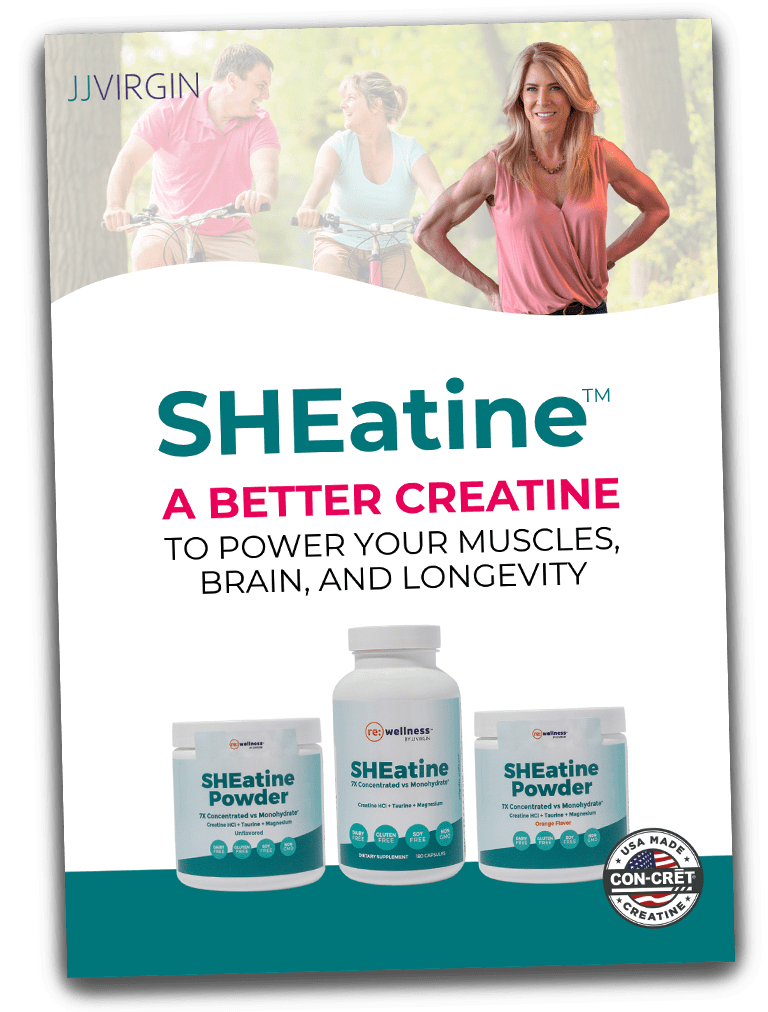
One of them is called Yolk by Meios can increase muscle protein synthesis in their research by up to 18%. Also, timelines might appear. Urolithin A that can improve muscle strength in untrained people not doing anything, they increase their muscle strength 5 to 11%. So imagine when you put it together with resistance training. And of course I’m gonna say Chiotine, my creatine, taurine and magnesium product that helps you work out harder, recover faster. These are all products I personally use companies I work with and I’ll put it all in the show notes. Now, here’s how I would approach this information. And I think this is the part that most women get wrong. When I’m working with women over 40, we don’t start with cardio. That comes later. We start with resistance training.
08:45
Speaker 1
I want you to challenge your muscles with two to three resistance training sessions per body part per week. That’s the foundation. And then we’re making sure you’re getting in your daily movement. Then I’ll add in high intensity interval training. But muscle comes first. Muscle is your metabolic control center. It supports bone health, helps protect against sarcopenia, it stabilizes your blood sugar, and it just helps you stay active and independent and powerful for the long term. I’ve seen women completely change how they feel, how they move, how their bodies respond simply by shifting their focus to getting stronger and challenging those muscles. So here’s the one thing I want you to take away from all of this. Strength is not optional. As you age, it’s one of the strongest predictors of how long you live and more importantly, how well you live.
09:31
Speaker 1
So instead of just focusing on moving more, let’s start focusing on getting stronger. Let’s put that intention into your movement. Now, if this gave you a different way to think about your health, make sure you subscribe so you can stay strong, independent, and metabolically healthy as you age powerfully. Because when you prioritize muscle, you change everything about how you age. Be sure to join me next time for more tools, tips and techniques you can use to look and feel your best and be built to last. Thanks for tuning in and I’ll catch you on the next episode. Hey, JJ here. And just a reminder that the well Beyond 40 podcast offers health, wellness, fitness and nutritional information that’s designed for educational and entertainment purposes only.
10:23
Speaker 1
You should not rely on this information as a substitute for, nor does it replace professional medical advice, diagnosis, or treatment. If you have any concerns or questions about your health, you should always consult with a physician or other healthcare professional. Make sure that you do not disregard, avoid or delay obtaining medical or health related advice from your healthcare professional because of something you may have heard on the show or read in our show notes. The use of any information provided on the show is solely at your own risk.